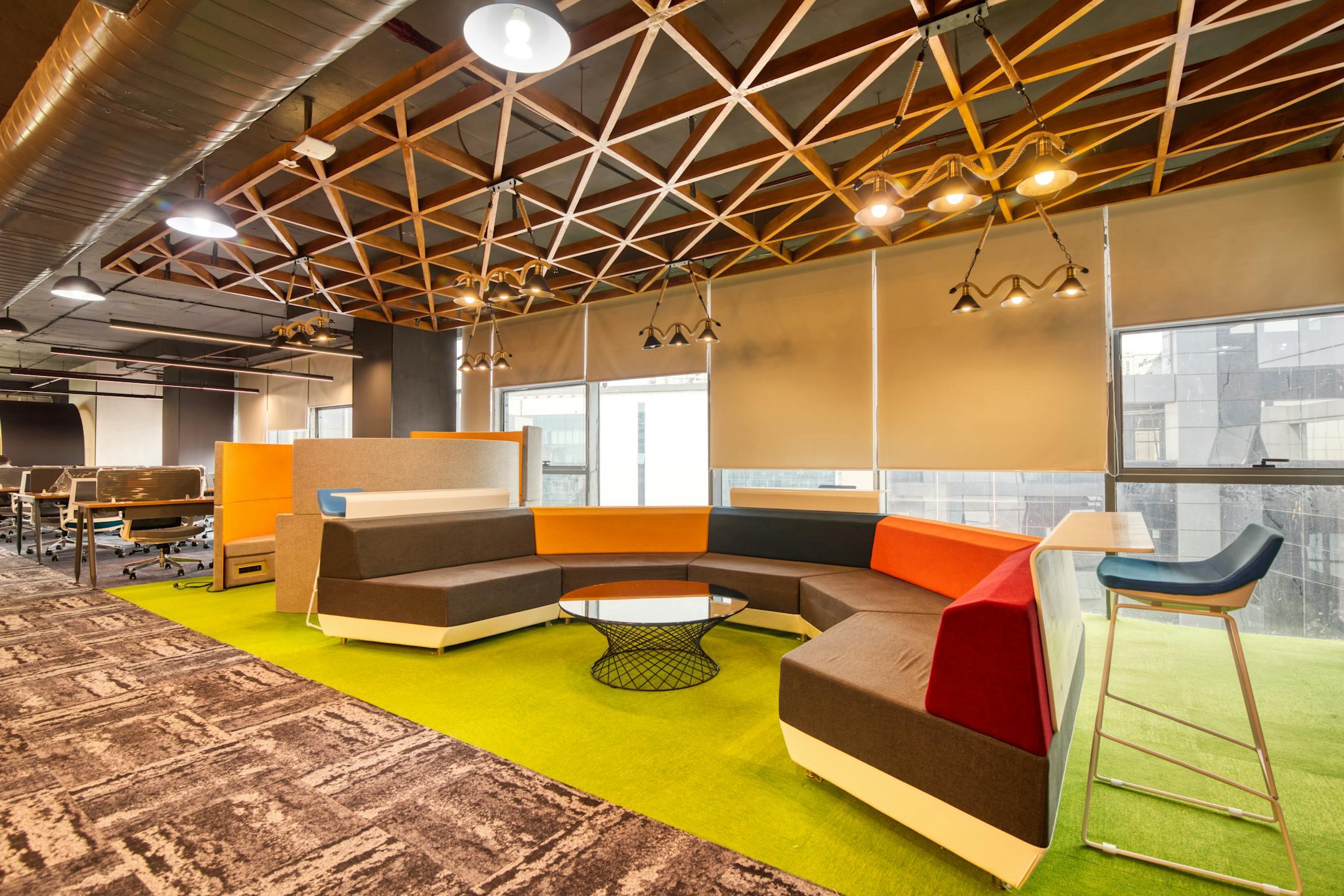
In today’s commercial market, space doesn’t lease itself. Vacant square footage is no longer enough. A TI allowance alone isn’t enough. And “we’ll figure out the build-out later” is a dangerous sentence.
Last week, I presented to a room full of commercial real estate professionals on a topic that directly impacts their commissions, their credibility, and their deal velocity:
Here’s what every broker — and every tenant — should understand about office build-outs in 2026.
When I ask brokers how many deals have stalled because a tenant “just couldn’t visualize the space,” the hands go up.
Research consistently shows that professionally designed and staged environments increase perceived value and reduce vacancy time. The National Association of Realtors has reported that staging helps buyers visualize a property as their future space — and the same psychology applies to commercial tenants.
When a tenant walks into:
They don’t see drywall. They see possibility.
In my presentation, I shared that well-designed spaces can lease up to 30% faster because tenants can understand how the space works for them.
And faster leasing means reduced vacancy and stronger broker performance.
Here’s a moment from the presentation that always lands:
“When a tenant hears they have a $50 per square foot TI allowance, they think that covers the whole project. But that usually only offsets a portion of hard construction — not the full build-out, and not soft costs.”
Let’s break that down.
Hard Costs (Construction)
Demolition, framing, drywall, electrical, lighting, HVAC, plumbing, millwork, flooring — the physical construction.
In San Diego in 2026, hard costs for a typical office TI often fall in the $80–$120+ per square foot range
Soft Costs (Planning & Professional Services)
Interior design, architectural drawings, MEP engineering, permit fees, energy compliance (Title 24), project management, renderings/test fits.
Soft costs typically add 15–30% of total project cost, often translating to an additional $15–$40+ per SF
So when you combine hard + soft:
Total realistic build-out costs in major SoCal markets often land in the $140–$180+ per SF range.
Now compare that to a $50–$60 TI allowance.
That gap is where deals collapse.
Brokers who understand this early protect their clients — and themselves.
If construction surprises tenants, furniture shocks them.
From the presentation: “Most tenants underestimate furniture more than construction.”
Furniture is typically NOT included in landlord TI allowances. It’s a separate capital expense.
Planning ranges in 2026:
For a 10,000 SF office, even entry-level furniture can mean $250,000–$500,000.
And furniture isn’t cosmetic. It directly affects:
According to Gensler’s Workplace Survey research, workplace design quality directly impacts employee engagement and performance. That matters to companies returning to office environments and trying to retain top talent.
Furniture is not an afterthought. It’s a business decision.
One of my closing slides said it best:
“Design isn’t decoration. It’s risk management.”
When we manage hard and soft costs early:
Design aligns the vision, budget, and operational needs before surprises arise.
That’s not aesthetic work. That’s strategic work.
The brokers who consistently close stronger deals do three things:
When brokers can say,
“We’ve already validated that your build-out will realistically cost X,” they become trusted advisors — not just transactional intermediaries. That builds long-term relationships.
Commercial real estate is no longer just about square footage.
It’s about:
Design impacts all of it.
And when design is integrated strategically, it doesn’t just make spaces beautiful.
It closes deals.
If you’re a commercial real estate professional in San Diego who wants to:
Because great space doesn’t just happen.
It’s planned.
And when it’s planned well, everyone wins.
 San Diego Office Design
Proudly based in San Diego, we’ve been bringing West Coast style to clients near & far for 17 years. Woman-owned & Led. (WOSB, DBE) NAICS 541410, 442110 (We sell furniture and services to the government and city, as well as to clients like you!)
Read our latest article about the ins and outs of commercial interior design! Read Here!
